

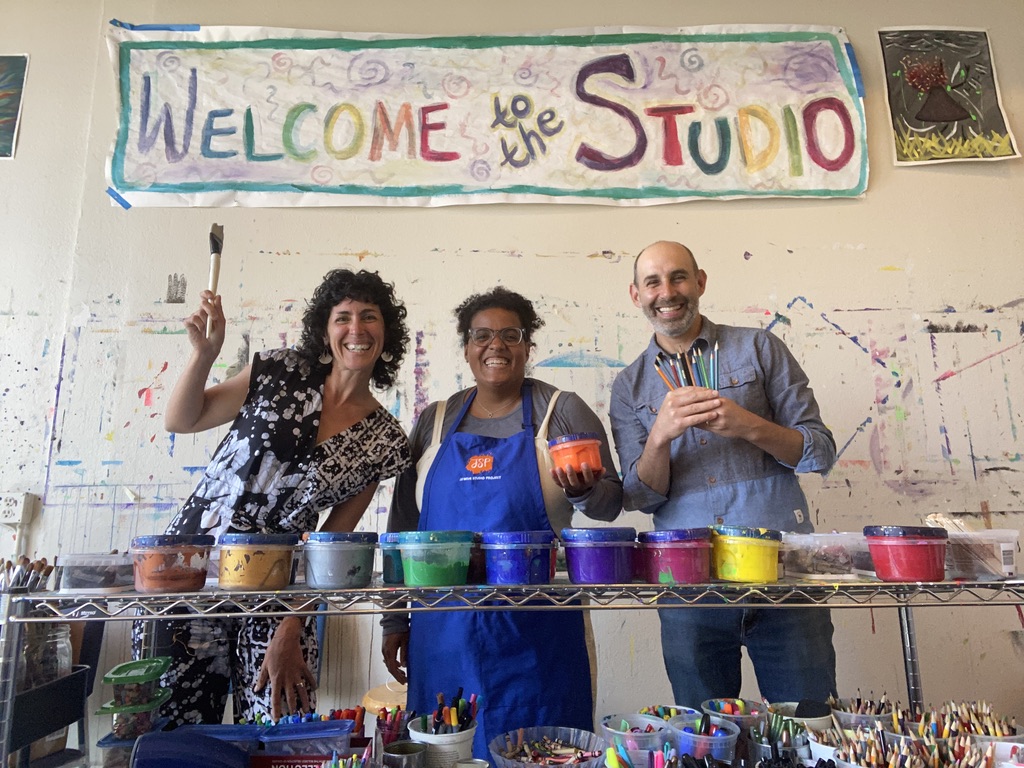
JSP co-founders Adina Allen and Jeff Kasowitz with current Board President Dr. Imani Chapman
By Cathy Rosenfeld
How often have you heard someone say, “I’m not very creative” or “I’m not good at art”? Well, Netivot congregant and Jewish Studio Project (JSP) co-founder Rabbi Adina Allen is not having it! She believes that creative power is not only within us but is a sacred and vital part of us. As R’Adina explains, “Creativity is a code word for God. It is a spiritual life force, an energy that is both beyond us and lives within us. Touching our creativity is sacred because we are touching the divine connection.”
JSP facilitator and Netivot congregant Jeanne Reisman put it this way, “If we are all b’tselem Elohim, created in God’s image, and God creates, so we too have the capacity to create.” And the goal of creating isn’t just to make something; it can be to experience the force of our creative energy. As one of R’Adina’s teachers, Susan Magsamen, put it at JSP’s recent 10th anniversary celebration, “Creating is not escaping reality, but building the capacity to meet it in new ways.” So who is R’ Adina, what is the Jewish Studio Project, and how does JSP foster our innate creativity?
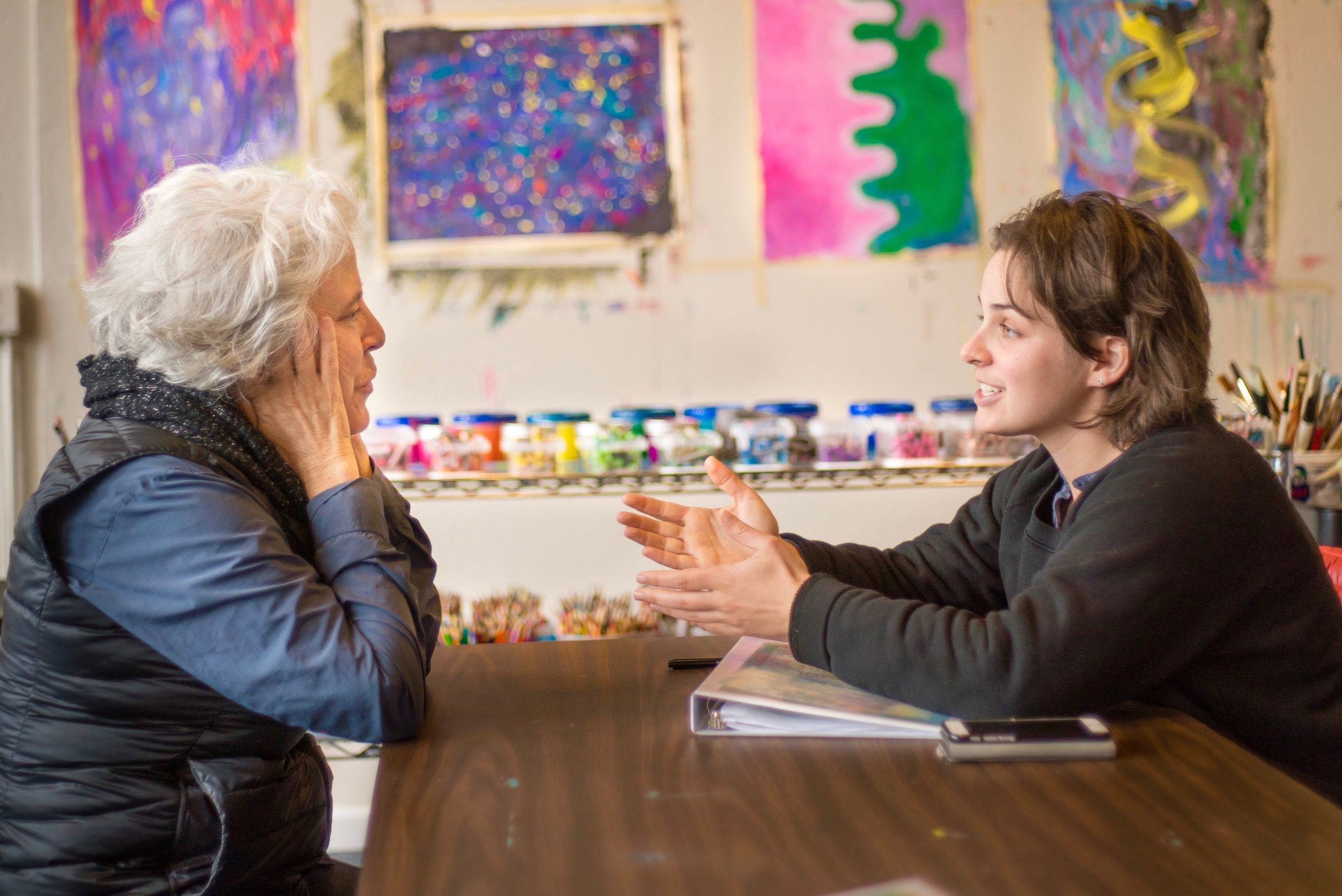
R’Adina had the good fortune to have a world-renowned art therapist (Pat Allen, also a Netivot congregant) as a mom. Pat’s art studio was the biggest room in their Chicago home and Adina got to explore not only the home studio, but also the community art spaces at the Open Studio Project which Pat co-created in 1991 to enhance wellbeing through art. Eventually Adina and her life partner Jeff Kasowitz merged their passion for Judaism with the Open Studio Process to create the Jewish Studio Project (https://www.jewishstudioproject.org), but before that happened, R’Adina did a lot of creative exploring of her own.
Among all her childhood experiences in the organized Jewish world—a Reform temple, NFTY, Jewish summer camps, tutoring b’nei mitzvah students, a semester in Israel—the most salient ones were moments of prayer in the woods at camp. That connection with nature motivated her to study climate change at Tufts University and to do environmental field work in the global politics of oil and water. The weightiness of what she was learning led her to do her senior project on how the Open Studio Process could be used to process the emotional component of intellectual work.
Exploring ways to engage with the challenges of the world and move forward as human beings–art and ritual and prayer and song–Adina learned about the new Rabbinical School of Hebrew College in Boston, but before studying there, she moved to the Bay Area where she met and fell in love with Jeff Kasowitz. With Jeff’s background in business and public health (MBA/MPH from Cal) and R’Adina’s background in art and Judaism, they started dreaming of starting a new Jewish spiritual creative organization to foster wholeness and community.
JSP’s origins
After R’Adina completed her Rabbinic training in Boston in 2014, they returned to the Bay and launched the Jewish Studio Project with a grant from UpStart Bay Area, an incubator for Jewish start-ups. R’Adina fully credits Jeff with being “the force of organization and strategic planning. JSP has been built because of his leadership and entrepreneurial skill.” A year and a half ago, Adina and Jeff joined Netivot Shalom. They were looking for a synagogue that was rooted in tradition and a good fit for their family and found that “and more” at Netivot. R’Adina says, “Something inspires me every time I come. There is so much knowledge of different kinds.” We are lucky to have Adina and Jeff and their family at Netivot and lucky to have the Jewish Studio Project in Berkeley!
When asked to describe JSP in simple to understand terms, R’Adina said, “It is a way for people to cultivate a connection to their creativity.” R’Adina believes it is a tragedy in our culture that if you are not deemed “artistic,” you are discouraged from making art. We sing in shul because song releases something in us, not necessarily because we are trained as singers. Similarly, art is a way “to drop down from the intellect into the imagination and emotion and to see what is there beneath the surface.”
Art is the “S” of JSP (Jewish Studio Project) and beit midrash (house of study) is the “J.” Engaging with Jewish text and finding new meaning in Torah are in the beit midrash tradition. R’Adina notes that while our interpretive tradition has been closed for many years, the text says there are 70 faces to Torah and we are all enriched by new interpretations. JSP allows many different voices to access the text through its practice and methodology because “The process of art making allows for going past words. It is a way to develop intuition and imagination that may have languished. JSP weaves beit midrash and art making together.”
What is the JSP process?
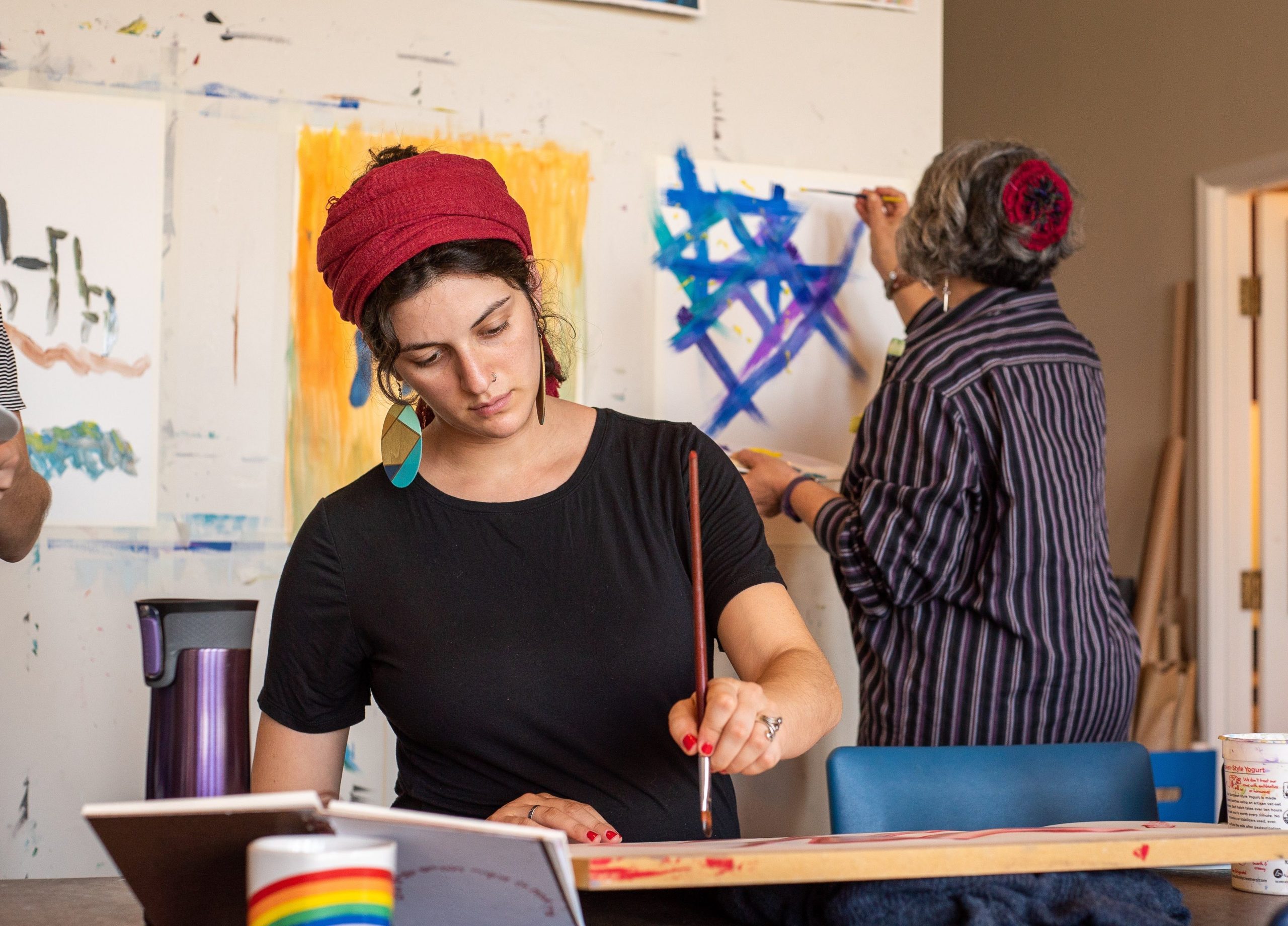
Engaging with text and making art are two of the four specific steps of the JSP process: inquiry, intention, creative exploration, and reflection. A session typically starts with a trained facilitator sharing a piece of Jewish text and other texts (which may or may not be Jewish) on a particular theme. Participants then engage in chavruta study (talking with a partner) about the texts. After the group comes back together to share what they have uncovered, each participant sets an intention, using a verb in the present tense such as “I explore” or “I discover” or “I let go of…”
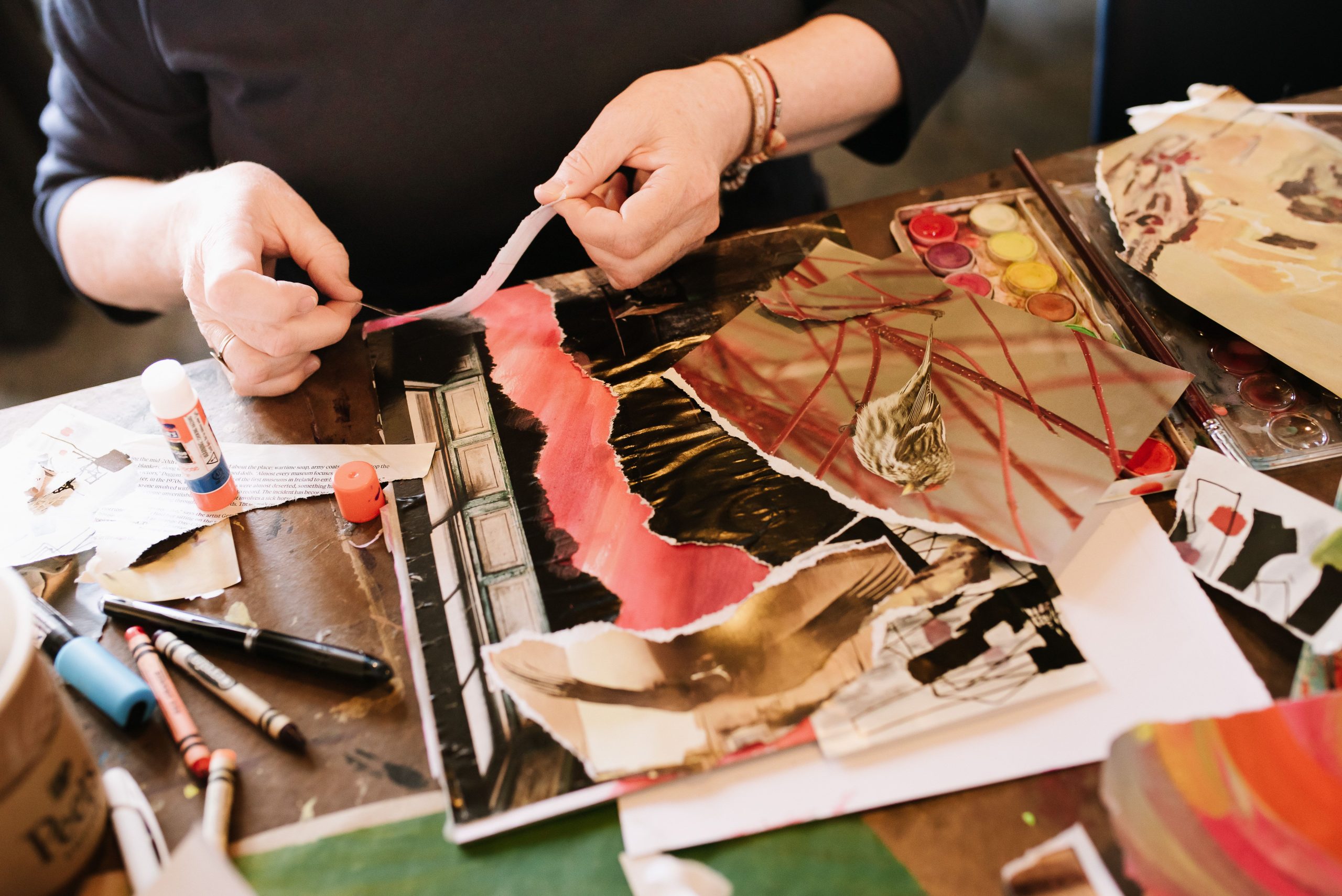
The next step is to make art, choosing from and using a wide variety of art supplies and materials. R’Adina says that making art “allows for interpretations to come through that wouldn’t necessarily come through in text study alone.”
Then participants reflect on what they made by journaling, what is called in the Jewish Studio Process “witnessing.” The final step is the optional reading of what you wrote aloud to the group, who listen but do not respond. In fact, unlike in many art spaces where compliments and critiques are commonplace, JSP has a “no comment” rule. Netivot congregant and JSP facilitator Lee Bearson says that he has come to really like the reading aloud part of the process. “You don’t always even understand what a person wrote, but you are a witness to their process. A big part of it is letting people hear their own voice, getting to say something out loud to a room.”
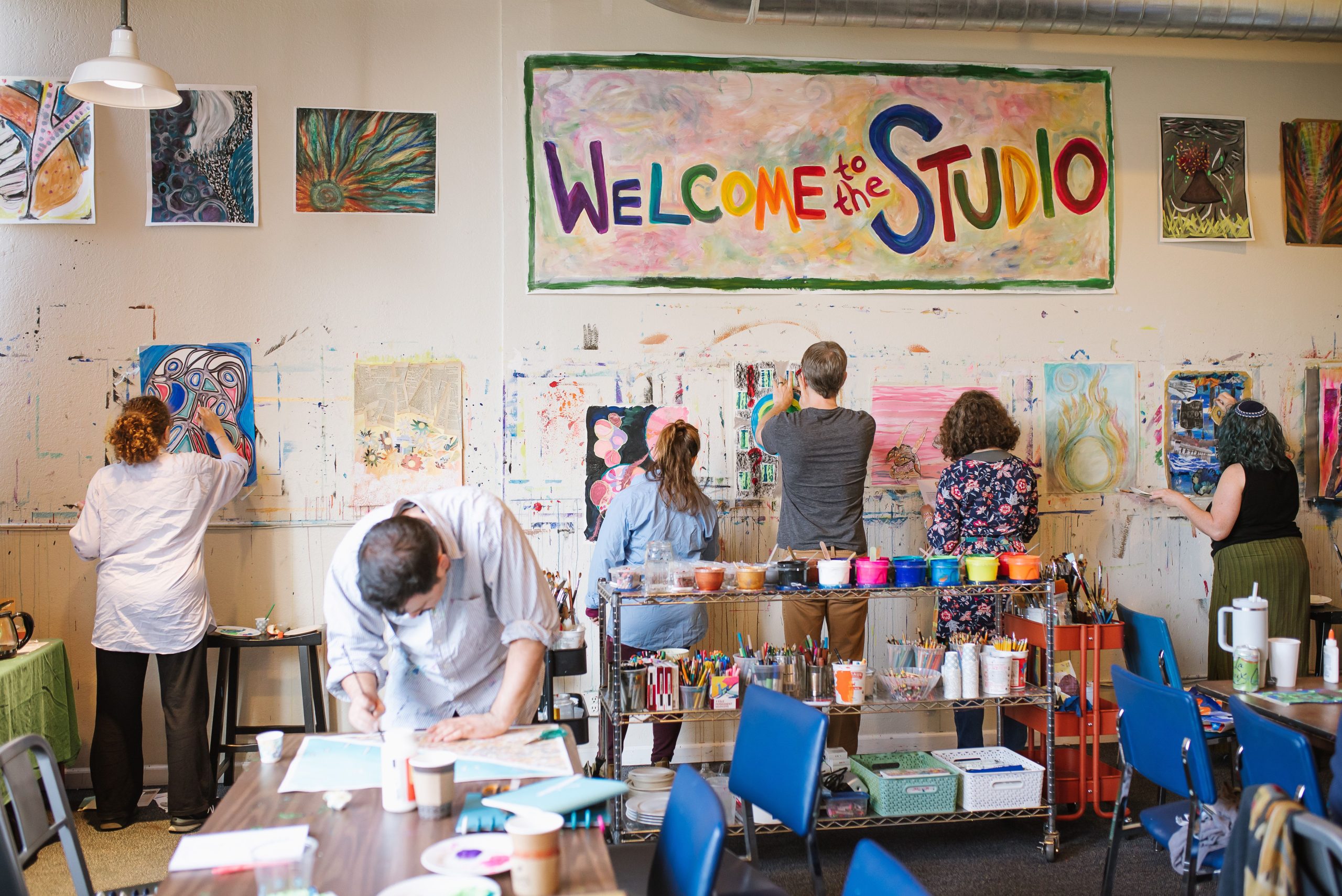
When asked to describe how the transition from discussing text to making art happens, R’Adina says that writing down your intention starts the process. Then, you start working with the materials and see where you go. “At Sinai, God says, ‘You will do and then you will understand.’ Art making is a somatic experience. You can get into a flow state in which you are just moving your hands, following the pleasure, the energy. What calls your attention? Maybe yellow attracts you and then you get bored with yellow and add pink. You don’t know why you chose pink or yellow. Or you start by making a mark. What is it? Maybe it shifts or you change it. You are led by another part of yourself and at the end, you are in a different state. Then you go back to words and write about what you did and what came through in your piece and receive insight from it.”
If you feel uncertain about whether this kind of exploration is for you, that’s not a bad thing. As R’Adina explains, “Uncertainty as a generative force. Both the beit midrash and art making parts of the Jewish Studio Process give us practice in being with uncertainty. Just as words can mean different things in Torah, in art making, there is a lot of uncertainty, and that is ok. We want certainty so badly. We want to know how to solve something, what the outcome is going to be. But in reality, our whole lives are a practice in being with uncertainty. We often jump to conclusions so quickly. Being uncertain is a skill to practice. The Jewish Studio Process allows us to be with uncertainty and to play with the generativity there.”
The walls of the JSP Berkeley studio are decorated with the “Torah of Creativity,” the four foundational principles of JSP, each corresponding to a phrase from Jewish text: Humans are created creative (b’tselem Elohim); creation comes from chaos and void (tohu va’vohu); nothing is ever just one thing (hafoch bah); we are called to journey into the unknown (lech l’cha); God is process (ehyeh asher ehyeh). R’Adina believes that when we bring our creative energy into a world full of chaos and void and imagine something that doesn’t yet exist, “New worlds are born. Our creative energy is hopeful and powerful.” Even doing the Jewish Studio Process a single time, according to R’Adina, “has the potential to unlock and open, leading a person down new paths.”
Member engagement
Many Netivot congregants have taken JSP workshops and speak enthusiastically about their experience. Quite a few have gone on to become trained facilitators. Longtime congregant Lisa Sibony shares this reflection on the JSP workshops she has participated in: “Jewish Studio Project is a welcoming space, where their thoughtful routines and use of text are both inspiring and down to earth, making sure that everyone finds a way to connect with art.” Netivot congregant and poet Carol Dorf, who has facilitated JSP poetry workshops, comments that creating in a group is a different experience than doing it alone, “I love creating art in the context of other people. I really enjoy the process.”
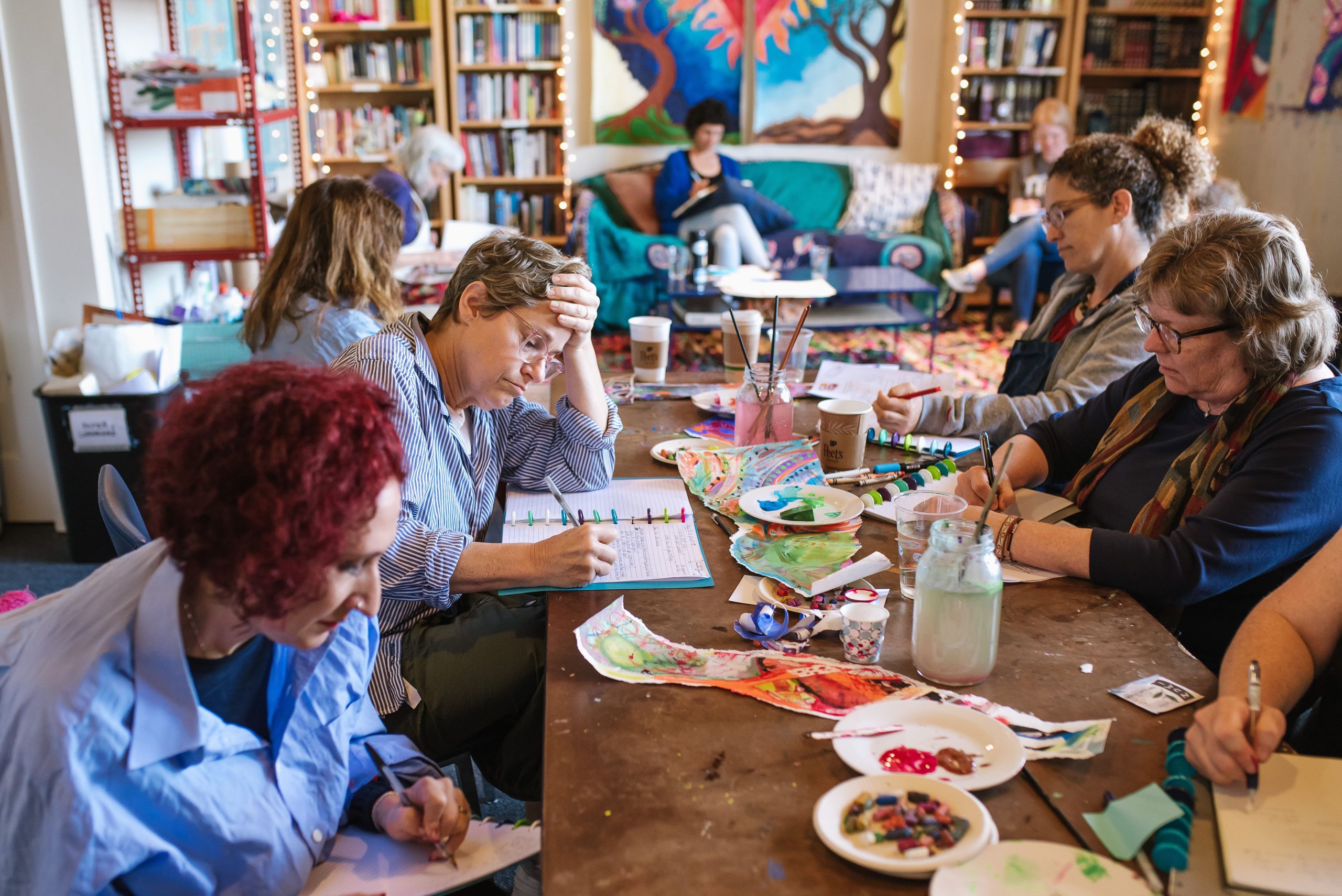
Mindy Geminder, another long-term member, has participated in several JSP workshops and says, “It is delightful to spend an evening looking deeper into the meaning of texts, writing and making art with my heart, mind, and spirit.” On the art making process itself, she shares that, “We are encouraged to ‘follow pleasure, make marks on the page, see where the energy takes you, with no comments on your own work or others, notice everything, and keep going.’ I enjoy the emphasis on the process, not the product. As a glass artist and sculptor, I usually spend months creating artworks, so it is refreshing to let myself freely create whatever comes to my mind and my heart in just an hour.”
Netivot congregant and JSP-trained facilitator of The Mourner’s Studio (a joint program of Netivot’s Chevra Kadisha and JSP) Jeanne Reisman says that participating in JSP “really enlivened my connection to Judaism. It has opened a door for so many of us.” Jeanne had retired from her career as a physician when Netivot’s Chevra Kadisha asked her to lead an art program for the bereaved. After that program, Jeanne trained as a JSP facilitator, understanding that she could combine her “love of text study with being an artist and my desire to be able to hold space for people navigating grief.” Jeanne comments that “a lot of people at my age narrow their focus. For me, the Jewish Studio Project has opened me to new possibilities.”
Netivot congregant and JSP facilitator Lee Bearson appreciates how “all the elements of the process build on each other with a back and forth happening between the mind and the heart, between the cerebral and the tactile.” He comments that for people who have had a lot of exposure to Jewish thought and study, the JSP process adds a different level to one’s engagement with Jewish texts. It asks, “How does this affect me on a deep level?”
Sarah Stone (who also has a new member profile in this issue) says, “I wouldn’t be at Netivot if it weren’t for JSP giving me a personal relationship with Torah.” Sarah describes the impact of the Jewish Studio Process this way: “Sometimes in Jewish spaces, there is almost an escalating game of how much you know and how many references you can cite. At JSP, we were able to study text without a context of proving ourselves learned. The approach is more like here’s the text and some other kinds of text. What are the reverberations for you and what art can you make out of it? After the first day, my partner Ron and I said, ‘How can we join this?’.”
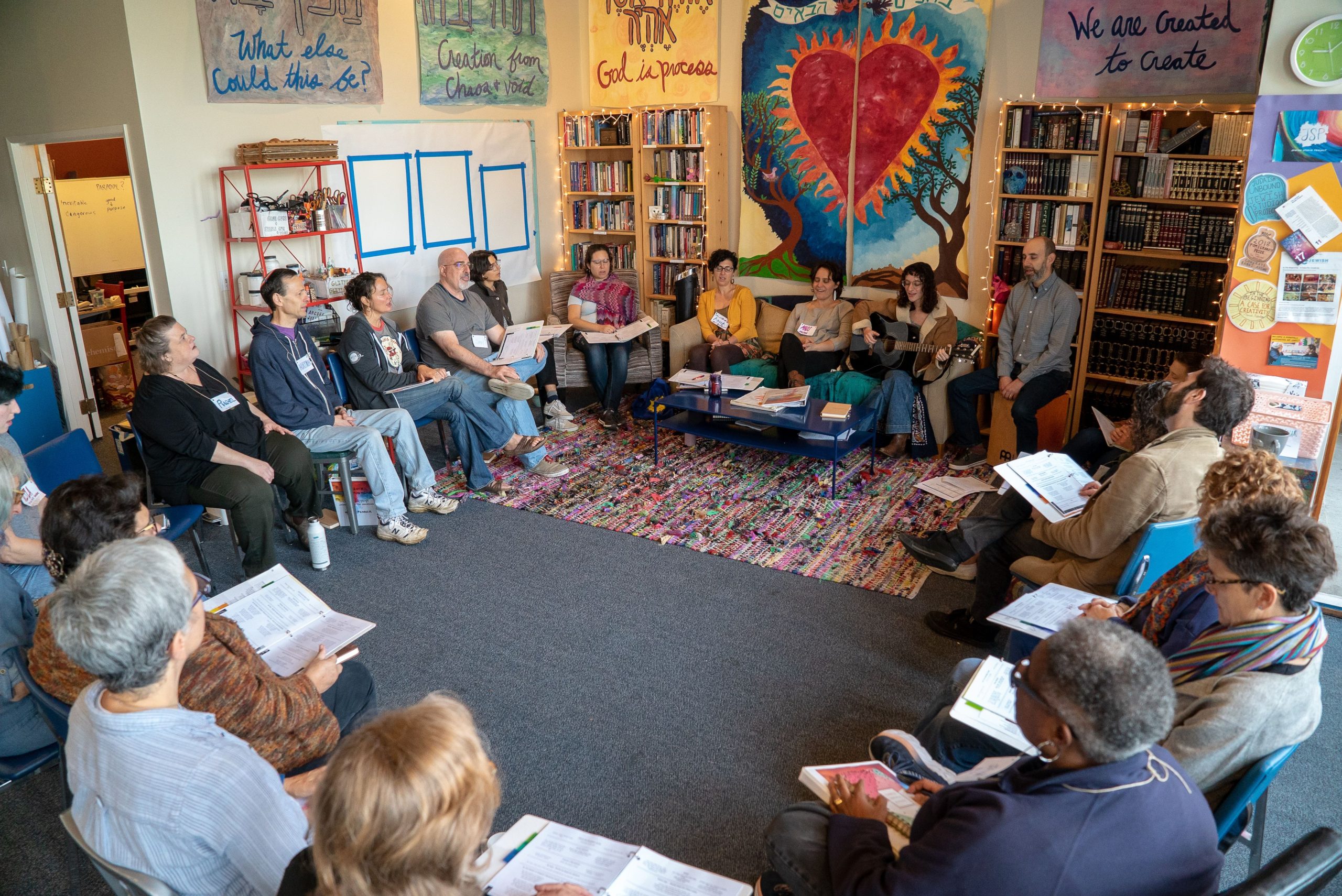
Sarah credits JSP not only with getting them through the pandemic (JSP held Zoom sessions as often as 5 times a week!), but also with unlocking their creativity, improving their work as a creative writing teacher, and developing resiliency in other aspects of their life. “This kind of work puts you in touch with Jewish tradition and art making and creativity. It opens a pathway to be able to listen to your deepest self, what Adina calls ‘the source,’ what some would call God. It puts a line through what is happening out in the world, our text and traditions, and what is happening in your soul. I was permanently changed by it.” Like Carol, Jeanne and Lee, Sarah also became a JSP facilitator. When asked to recall a powerful moment from a workshop they led, they said that someone they knew came to a session once as a favor but said afterwards, “I thought the rest of you were creative and I wasn’t, but now I understand I can have that too.”
If you are curious to “have that too,” check out JSP’s local events and free monthly Zoom workshops here https://www.jewishstudioproject.org/bay-area. With spring all around us and Passover coming right up, it’s a great time to reconnect with our own creative life force!