
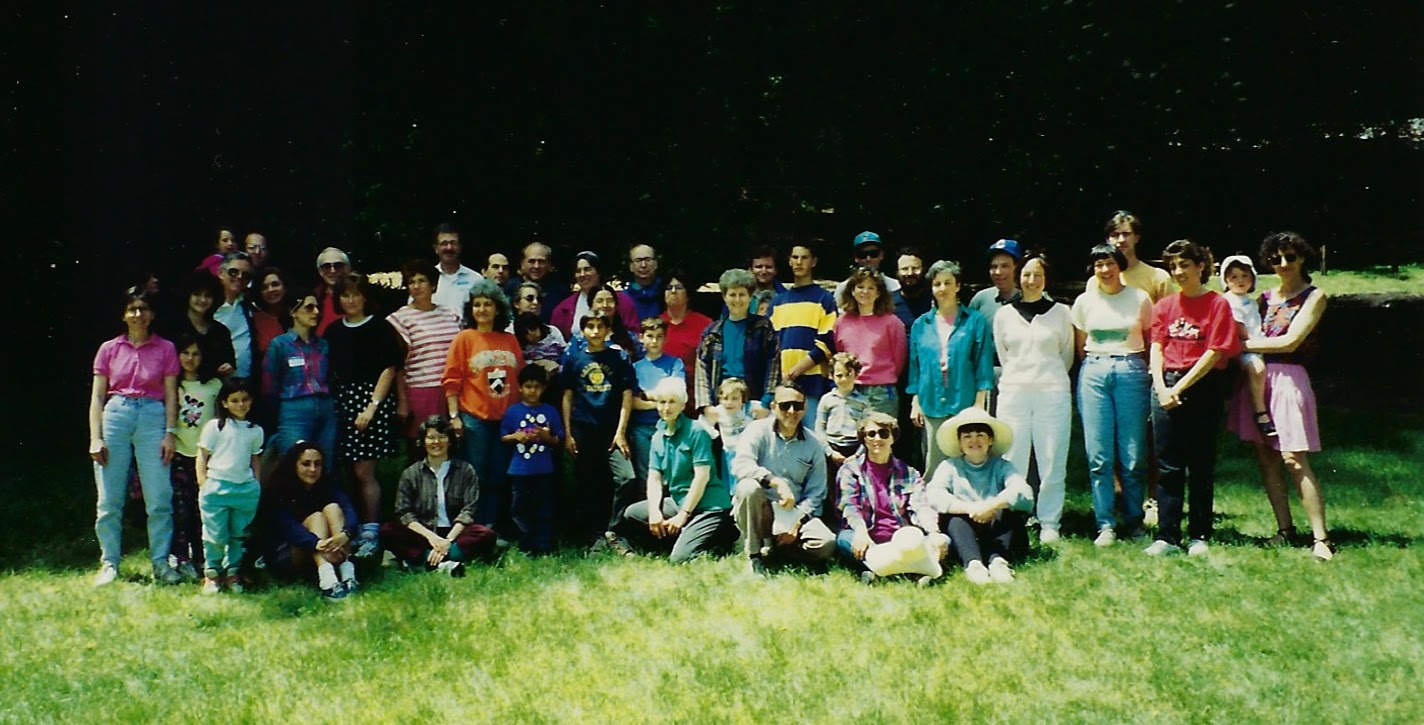
The upcoming Netivot Shalom May 15-17 retreat at Westminster Woods in Occidental will take place exactly 34 years after our very first retreat on May 15-17, 1992 at Valley of the Moon Camp in Glen Ellen. While the journey from Valley of the Moon Camp to Westminster Woods takes only 1 hour, the journey Netivot Shalom has traveled since our first retreat is a very long one. In 1992 with 236 “member units” and an annual budget of $176,150, we were renting space at the Berkeley JCC. In 2026, with 352 member units and an annual budget of approximately $1.6 million, we have our own beautiful building. We have come a long way, but perhaps the need to retreat and spiritually recharge is greater than ever!
Our first retreat, just 3 years after the founding of our shul, was called a Shabbaton. Art Braufman chaired what he says was a GREAT retreat planning committee. Unfortunately, I was not able to find a list of the members, but if you were on that first retreat planning committee and are reading this, THANK YOU for launching our tradition of regular retreats! Thanks to Art’s very detailed notes (and their sitting on a shelf in our library all these years) as well as our archive of old newsletters, we know a lot about the retreat. About 50 congregants attended, paying $175 per adult and $75 per child ages 6 to 11. There was no charge for children under 6. That was an all-encompassing fee, including room and board from Friday at 4:00 PM to Sunday at 5:00 PM. Income from the participants was $5,437.50, fees to the camp were $3,790.21, and program costs including supplies, snacks, the song leader and scholar-in-residence fees, and counselors totaled $1,841.79, resulting in a deficit of $194.50. Not bad!
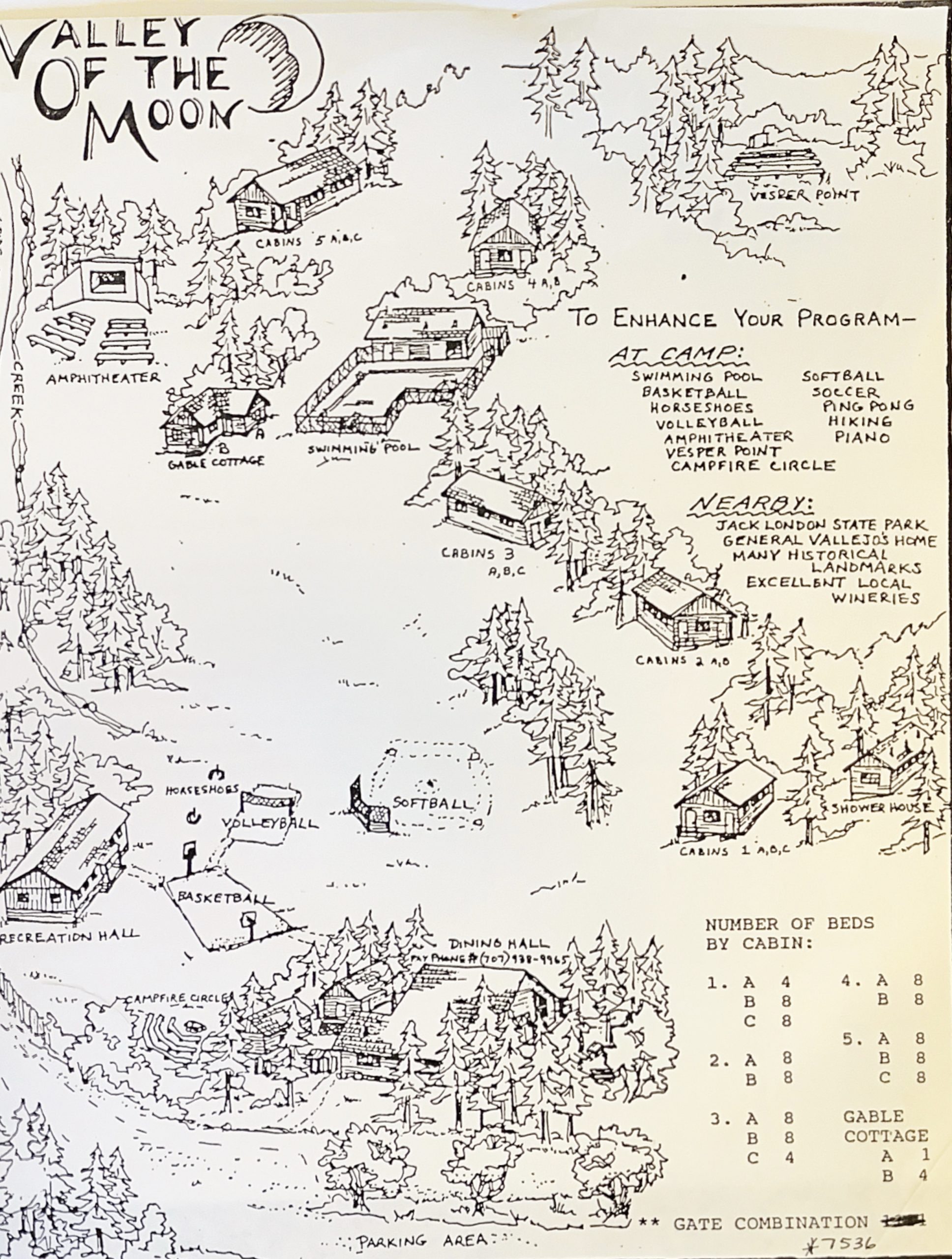
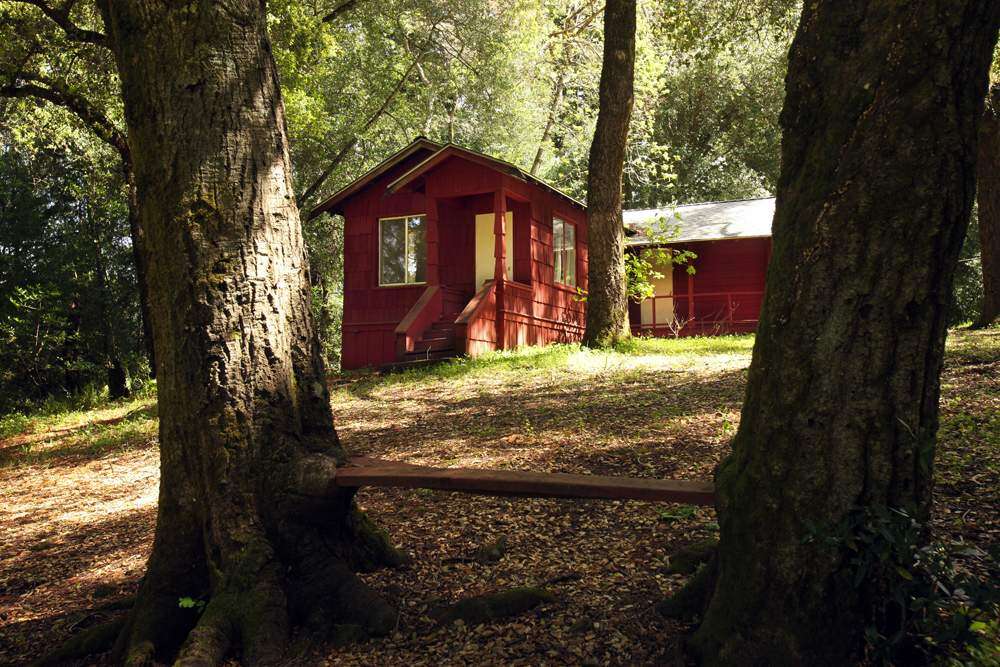
Valley of the Moon Camp itself has an interesting history. It was a horse ranch on the 3,000-acre Sobre Vista Ranch, originally part of General Mariano Vallejo’s property and acquired in the early 1900s by sugar magnate Adolph Spreckels and his wife, Alma. The Spreckels entertained lavishly on the ranch, hosting such notables as Charlie Chaplin and Mary Pickford. Clark Gable, married to a Spreckels, was a frequent guest, staying in his favorite cabin on the horse ranch. Alma Spreckels gifted the 23-acre horse ranch to the Presbytery of San Francisco (a governing body of the Presbyterian Church USA) which ran the Valley of the Moon camp as a retreat center for over 40 years. One of the camp’s cabins was called “the Gable Cabin” (see photo below) in honor of its most famous guest, the Gone with the Wind star, so on Netivot’s first retreat, some of our congregants slept in the Gable Cabin! Valley of the Moon closed in 2013 and is now a private property.
The camp had never hosted a Jewish group before and according to Art’s notes, the camp manager was initially overwhelmed with requests to kasher the kitchen, not cook on Shabbat, use only glass/stainless/metal mixing bowls and serving dishes, turn on the coffee urns Friday night, and not use knives with wooden handles. At one point, Art noted in red ink that the camp cook said that she had always cooked on Saturdays and “absolutely had to,” and the camp manager eventually told Art that the camp unfortunately couldn’t meet Netivot’s needs. That conversation happened after months of planning with 40 people already signed up. Somehow with Art’s negotiating skills, an offer to “keep things as simple as possible,” and a proposal to bring some already prepared food, the camp agreed to proceed and a menu was agreed upon. The camp manager made an amusing note on the retreat committee’s proposed menu–next to the word “blintzes,” he wrote in all caps, “I DON’T KNOW WHAT THIS IS! THANKS.”
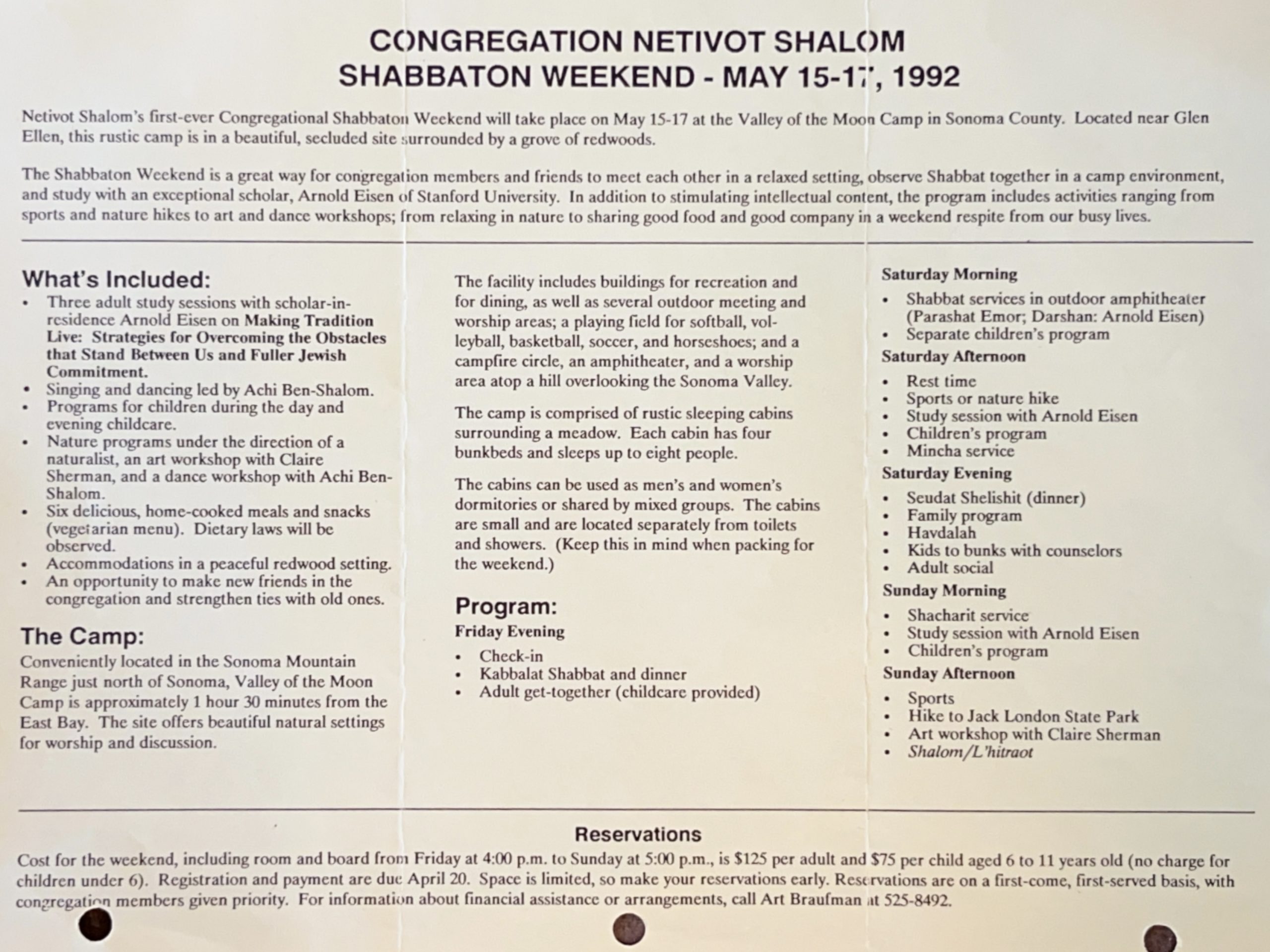
In the pre-digital age, flyers promoting the Shabbaton were mailed to all congregants with a note to call Art’s 7-digit home phone number (no need to dial 510 back in 1992!) with any questions. As you can see from the flyer (also preserved in our archives in the library), there were very few organized activities, with most of the weekend structured around services, time in nature, and study sessions with the scholar-in residence, Arnold Eisen (then Associate Professor in the Department of Religious Studies at Stanford and eventually Chancellor of the Jewish Theological Seminary).
In a June 1992 Netivot newsletter reporting on the Shabbaton, Seymour Kessler (Z”L) noted that “most of the daytime activities were held outdoors in the lap of nature…On Shabbat morning we davened under the redwoods with songbirds joining the chorus of voices singing in prayer, their chirps punctuating the leyning (reading) of the Torah. It was a singular experience, spiritually transcendent and precious. And there were many such moments during the weekend.” Seymour goes on in his article to credit the success of the Shabbaton to 3 factors: the tireless work of the planning committee; the active participation of the musician-in-residence, Achi Ben-Shalom; and the stimulating contributions of the scholar-in-residence, Arnie Eisen.
Claire Sherman, who led an art workshop, remembers the lovely singing throughout the weekend led by Achi Ben-Shalom. She recalls, “There was one evening when I was preoccupied with something and not in the mood to sing (and it’s very rare for me not to feel like singing!), but Achi somehow changed my mood, and I felt like singing after all.” Seymour wrote in his newsletter column that Achi taught many new melodies which “will undoubtedly become part of our community activities and prayers.”
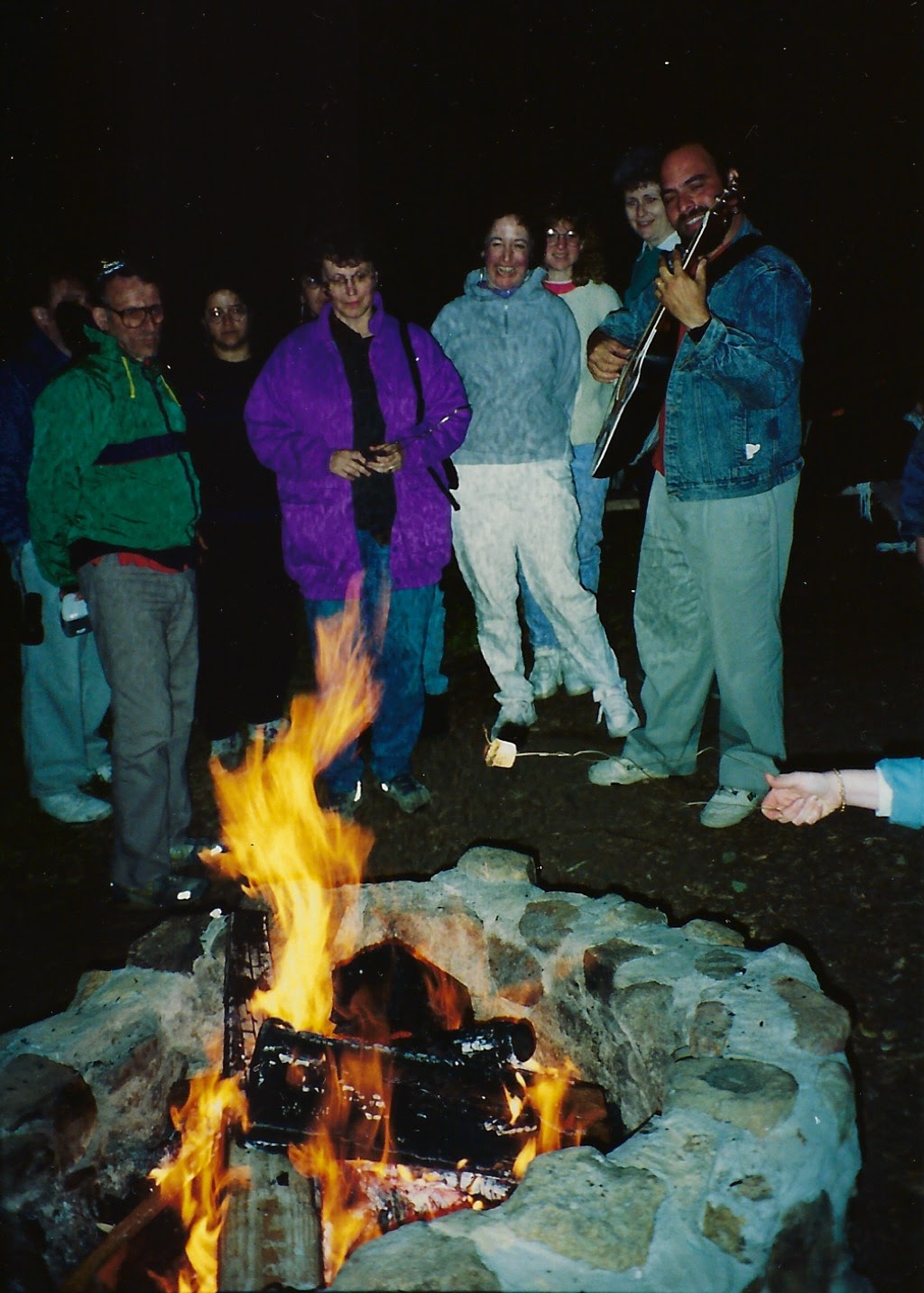
In his three study sessions, Arnie Eisen covered many topics relevant to the Conservative movement, emphasizing, according to Seymour, Conservative Judaism “as a vital force in perpetuating Jewish tradition because of its concomitant acceptance of tradition and broad tolerance of diversity and differences; the movement tries to include rather than exclude.” Netivot congregant Nancy Bardach wrote in the newsletter that Eisen’s seminars focusing on the enrichment of Jewish Conservative spiritual life were “engaging and exciting.” He challenged participants to ask themselves what they are doing, “every day, to find ways to meet the challenges of being Jews in this time and space.” Nancy reported that “Arnie consistently resisted our every attempt to wail,” challenging us, as Conservative Jews, “to take on the opportunity and the responsibility of seeking answers to… important questions of identity and belonging.” Her article ended with the declaration, “A good think was had by all.”
Both Art Braufman and Ethel Murphy emphasize the joy of forming closer community bonds that a retreat offers. In time away from our own homes and worries, in a natural setting with song and prayer and conversation, we connect in a different way than we do at services or events in our building. Art said that retreats are always “a great way to meet new people” and Ethel remembers from that first retreat 34 years ago that “there was a lot of community building and it was very worthwhile.”
And now it’s time to relax, revitalize, connect with Jewish thought and prayer in the great outdoors, make new friends, and deepen our communal bonds at our upcoming May 15-17 retreat at Westminster Woods!